
10 Best Drinks for Liver Health and 5 Drinks to Avoid
LIVER WELLNESS · DAILY HABITS Your liver works around the clock to process nutrients, filter...
Most wellness brands stop at the herb. We went further. This is the full story — the problem science discovered, the report that confirmed our choice, and the solution we built Brinita around.
You’re Drinking Billions of Plastic Particles. Every Single Cup.
Tea feels ancient. Natural. Safe. Hot water, herbs, ritual. Most people never question the bag holding those herbs — because it looks harmless. Some are beige. Some look like mesh. Some are shaped like little pyramids. They all appear to be part of a healthy, conscious choice.
But science tells a very different story about what’s happening the moment that bag hits boiling water.
Researchers at McGill University found that a single conventional teabag, steeped in boiling water for five minutes, releases approximately 11.6 billion microplastic particles and 3.1 billion nanoplastic particles — directly into your drink. A follow-up study by scientists at the Autonomous University of Barcelona confirmed that these particles are absorbed by human intestinal cells and can migrate into the bloodstream.
“Frequent tea drinkers could be repeatedly dosing themselves with billions of plastic particles, some small enough to potentially infiltrate human cells.”
— Beyond Plastics Research Summary, citing multiple peer-reviewed studies
Microplastics have now been detected in human livers, lungs, hearts, brains, and placentas. The science is not alarmist. It is peer-reviewed, replicated, and growing.
Think about how many cups of tea you drink a day. Now multiply that by 11.6 billion. That is not a fringe concern. That is a daily, cumulative, entirely avoidable exposure — and most brands have simply decided not to talk about it.
We decided we couldn’t build Brinita that way.
We Didn’t Just Choose Differently. We Got It Certified.
Before a single Brinita teabag reached a customer, we sent our PLA non-woven teabag material to SGS — the world’s leading independent testing and certification body — for rigorous, third-party food safety testing.
We tested under EU Regulation (EU) No 10/2011 — the European Union’s gold-standard framework for materials in contact with food and beverages. These are among the strictest food contact safety standards on the planet. Most Indian brands don’t bother testing to this level. We did. Because you deserve proof, not promises.
✓ SGS Certified — Food Grade PLA Non-Woven Fabric, SGS Shanghai
| Test Simulant | Limit | Result |
|---|---|---|
| 95% Ethanol (60°C, 2 hrs) | 10 mg/dm² | ✓ PASS |
| Isooctane (40°C, 0.5 hr) | 10 mg/dm² | ✓ PASS |
| Element | Result | Element | Result |
|---|---|---|---|
| As | ND | Zn | ND |
| Pb | ND | Mn | ND |
| Cd | ND | Al | ND |
| Hg | ND | Sb | ND |
| Cr | ND | Ba | ND |
| Ni | ND | Co | ND |
ND = Not Detected. All 20+ elements tested — within or below EU permitted limits. Overall result: PASS
The tests simulate the exact conditions of brewing — hot liquid in contact with the teabag material — and measure precisely what migrates out. The answer, across every test and every element: nothing harmful. No detectable chemical migration. No heavy metals. The bag holds the herbs, and nothing it shouldn’t be releasing enters your cup. This is not a claim. It is an independently verified, signed, third-party laboratory finding.
SGS conducted these tests using internationally recognized analytical methods — EN 1186-3:2022 for overall migration, and ICP-OES/ICP-MS spectroscopy for heavy metals — the same methods required by European regulatory bodies for food contact material approvals.
This report exists. The numbers are real. And we’re sharing them openly because we think you should expect this level of transparency from every brand that claims to care about your wellness.
100% Plant-Based. Zero Plastic. Built on Ayurvedic Principle.
The answer we chose isn’t a workaround. It’s a return to the original principle of Ayurveda — that purity doesn’t stop at the ingredient. It extends to every vessel, every surface, every point of contact between the medicine and the body.
Brinita teabags are made from PLA non-woven fabric — a food-grade material derived entirely from plants, not petroleum.
Polylactic Acid — born from plants, not oil. PLA is a biopolymer made from fermented plant sugars, typically derived from sugarcane or corn starch. Unlike nylon, polypropylene, or PET — all fossil-fuel plastics — PLA contains no synthetic polymers. It doesn’t shed microplastics into your brew. It doesn’t persist in the earth for 500 years. And now, it’s been SGS-certified to prove it won’t release anything harmful into your cup.
“In our grandmother’s kitchen, the kadha was always brewed in clay or steel. There was no plastic anywhere near the healing process. That is the standard we hold ourselves to at Brinita.”
— Jyotsna Goyal, Ayurveda Head & Co-Founder, Brinita
Brinita was built in Jaipur, bootstrapped, by a family that grew up with Ayurveda as a daily practice — not a marketing angle. Our co-founder and Ayurveda Head, Vinita Goyal, brings generational knowledge of herbal formulation. Our teas are hand-blended in small batches, 100% organic, with zero artificial additives.
Choosing a plant-based, certified teabag costs more than using a cheap plastic one. We made that choice anyway — because the point of an Ayurvedic herbal tea is to put something deeply clean into your body, and that can’t happen if the container is working against you.
Yes. Multiple peer-reviewed studies confirm that nylon, polypropylene, and PET teabags release billions of microplastic and nanoplastic particles into hot water. These particles have been found in human blood, liver, lungs, and placentas.
PLA (Polylactic Acid) is made from plant sugars — not petroleum. It contains no synthetic polymers, so it does not shed microplastics into your brew. It is also biodegradable under industrial composting conditions, unlike conventional plastic which persists for 500+ years.
Yes. Our PLA teabag material was tested by SGS — the world’s leading certification body — under EU Regulation (EU) No 10/2011 for food contact materials. Both Overall Migration and Heavy Metals tests passed.
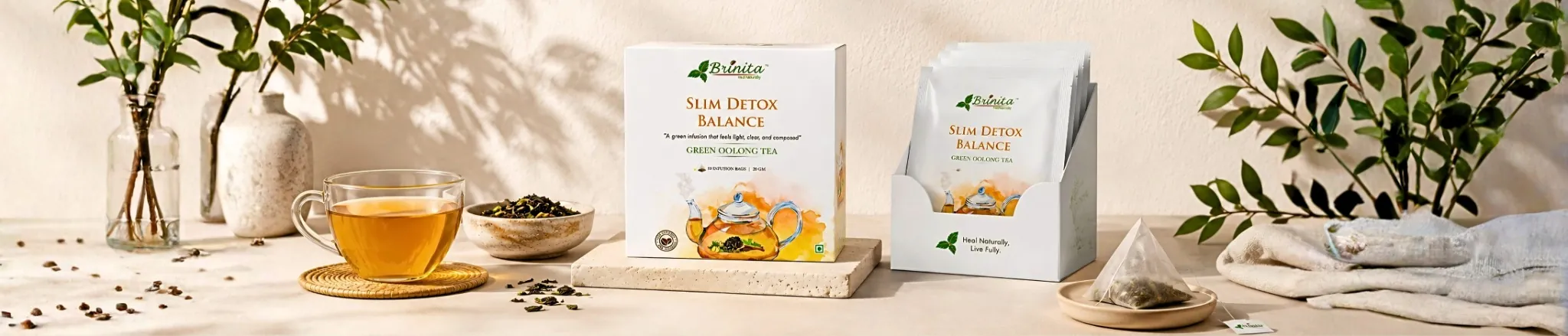
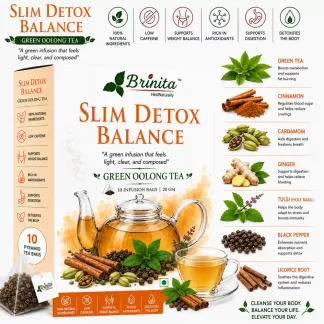
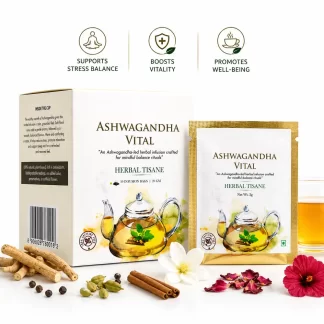
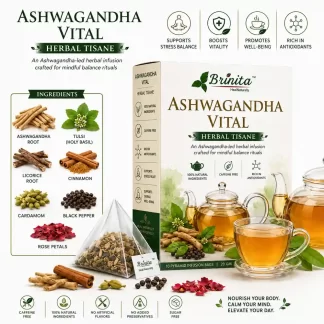
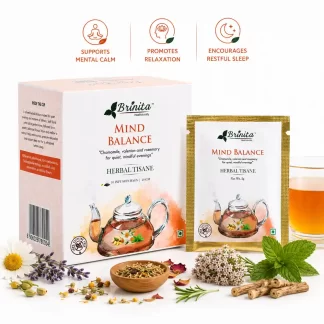
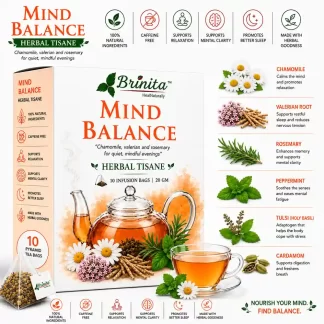
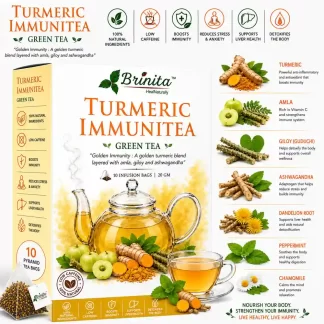
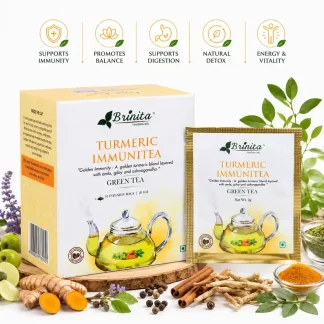
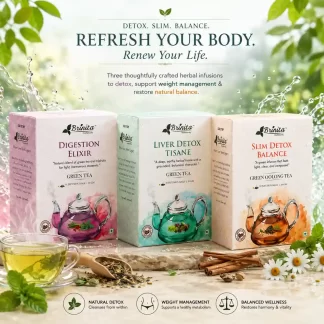
All of them. Every Brinita variant — from Ashwagandha Vital and Turmeric Immunitea to Slim Detox Balance and Mind Balance — uses the same 100% PLA plant-based, SGS EU-certified teabag. No exceptions.
Share this post:
Discover More Articles You Might Like

LIVER WELLNESS · DAILY HABITS Your liver works around the clock to process nutrients, filter...

A Summer Ritual That Defies Logic Why Indians Still Reach for Tea in Peak Summer...

1. The Sound Before the Smell A steel pot, a rooftop in Jaipur, and the...

When Sleep Duration Isn’t the Problem Why You Wake Up Tired — Even After Sleeping...

The Missing Half of the Wellness Equation Why Your Evening Routine Matters More Than Your...

An Origin Story Some Legacies Are Inherited Through Names or Professions. Others Are Passed Quietly...
Disclaimer The statements have not been evaluated by FSSAI. This product is not intended to diagnose, cure or prevent any disease. Children and pregnant women should consult a doctor before use.

0 Comments